
Controlled exercise is the foundation of any good training and rehabilitation programme (Gillis, 2014). When done correctly, lunging can be a great tool to gymnasticise your horse.
What is the best equipment to use for lunging?
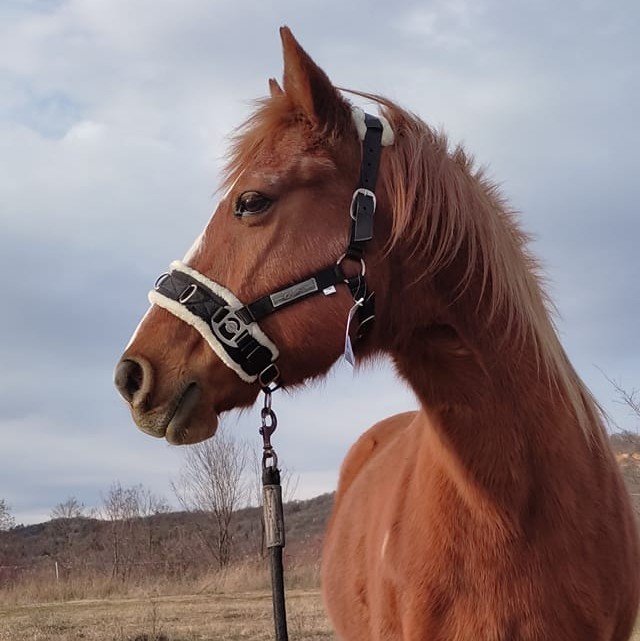
1. Cavesson
Avoid lunging in a bridle or headcollar as these tend to twist the poll instead of correctly bending it. This will activate the “wrong” muscles, causing suboptimal movement patterns and unbalanced loading of limbs—as well as other structures in the body. Tendons and joints are delicate structures that require a well-thought out training plan for longevity.
Although lunging in a bridle or headcollar is still common practice in some places, that alone does not make it right.
Ensure that your cavesson is correctly fitted. The noseband should sit 2-3 fingers below the cheekbone, still on the nasal bone, strictly above the nasoincisive notch. Attach your lungeline to the middle ring for a balanced bend. lungeline to the middle one.
2. Lunge line
Lunge lines come in many different styles. They can be synthetic, cotton or a blend of these two. Some have stops on them for a good grip, while others are rather soft. All of them can be a good pick, this mainly depends on personal preference. The key is to use a lunge line with a length of at least 10 meters or preferably longer to allow for a bigger diameter circle that does not compromise joint health and other structures in the limb.
3. Lunging whip
Similarly to lunge lines, lunging whips come in many different types and with different lengths. Aim to choose one that suits the size of circle you wish to lunge your horse in and your body size for optimal control.
4. Boots
Some horses may require brushing boots or overreach boots—or a combination of these two—strongly influenced by conformation, fitness, musculoskeletal health and training.
+1: Cones
In for a fun weekend activity? Give positive reinforcement lunging a try! For this you will need a marker (e.g. a clicker), some treats and approximately 10 cones—depending on the size of your circle and the learning stage of your horse. You can gradually increase the distance between cones or remove some as your horse starts to get the hang of the exercise.
An alternative to single line lunging is long-reining. If you only have a bridle and if it is safe to do so, this can sometimes be the better option to go for. Long reining can help build confidence in young horses and allows you room for creativity: you can use the whole school, incorporate polework and practice precise maneuvering around cones. You can choose to long-line in a bridle or cavesson. If you choose to long-rein your horse, make sure you choose a padded roller that provides clearance of the midline to avoid localised pressures on the spine, causing pain and discomfort (Mackechnie-Guire et al., 2018).
How to Lunge your Horse
First and foremost, ensure that all equipment is correctly fitted. Before starting the session, let your horse get used to every piece of gear—whip, lunge line, cavesson, boots, roller, etc. After time off or on days when your horse feels a bit “goofy,” a quick refresher may be needed.
You can lunge in a round pen or in any suitably enclosed space, such as an arena. Always check that the footing is appropriate: avoid slippery or hard ground, as well as working at the very end of a trimming cycle, to avoid discomfort, protect joint and tendon health and reduce the risk of injury. Deep sand should also be avoided; ideally, your horse’s hoof should not sink deeper than halfway.
If you want a long career for your horse, lunging itself should not be used as a warm-up exercise. Your horse should first be walked in straight lines before beginning work on the circle. Top tip: aim for at least 20 minutes of walk to allow for the production of synovial fluid, before moving into higher gaits, which lubricates the joints and helps them move smoothly. To prioritize joint health, make sure your warmup circle’s diameter is bigger than 20 metres.
Once your horse is properly warmed up, you can begin developing bend, engagement and collection from behind, progressing toward more advanced movements of groundwork.
Throughout your session, aim to work through the scales of training—rhythm, suppleness, contact, impulsion, straightness, and collection. These principles apply just as much to lunging as they do to ridden work.
Encourage your horse to bend correctly through the neck and back, preventing him from falling in or out of the circle. Support correct foot placement, a steady tempo, good balance, and coordination. During transitions, ensure that rhythm is maintained, watch if your horse adds any extra steps, these could indicate a musculoskeletal issue—which warrants for a vet workup.
For young horses, aim for sessions of about 20 minutes, avoid overworking. Shorter, positive sessions help maintain motivation. You can also reward your horse with scratches or treats, and teach a vocal marker such as “good boy” to reinforce correct behaviour later without interrupting the flow of the session.
Ask for transitions and include poles to keep the session interesting, to engage different muscle groups and to improve proprioception and balance. Polework also encourages your horse to lower his head and neck, which helps to lift the back. If your goal is for your horse to perform “long and low” I would recommend that you do this type of work from the ground. Allow breaks during a session. Keeping your horse in any frame for a prolonged period will create tension in the body and can build wrong patterns. Another thing to keep an eye out for when you ask for “long and low,” make sure your horse is not falling on his forehand, and that he has supple movement.

From a behaviour point of view, monitor your horse’s facial expressions for signs of stress and discomfort and adjust your session accordingly. If you ever feel that something is “off,” trust your instincts and have your veterinarian check your horse. Always consult your veterinarian.
Contraindications
Avoid lunging your horse if you notice any signs of pain. These may include asymmetric body leaning (Greve et al., 2018), lameness (even subtle), a stiff back, or generally restricted movement, a “pain face,” abnormal tail carriage, head bobbing, pinned ears, excessive tail swishing, reluctance to go forward or rushing, kicking out, rearing, picking up the wrong canter lead, cross-firing/cross- cantering behind, toe dragging, head tilting, spooking, or stumbling (Dyson, 2022)—to name just a few.
Avoid lunging for a longer period than recommended, especially horses whose growth plates have not fused yet. Lunging can be rather hard on joints and other structures. Always ask yourself: is my horse fit for lunging? What kind of exercise has he been doing in the past weeks and months?
Always start at the walk and only ask for higher gaits if your horse is physically fit for it. Remember, less is more.
Lunging can be an excellent addition to your horse’s regular exercise program. It can help improve your horse’s abilities and prepare him for ridden work. However, lunging should always be done sensibly and not on a daily basis as horses did not evolve to move in tight circles. When done excessively and long term, such movement could compromise their musculoskeletal health—resulting in poor performance and reduced longevity.
For personal-training and rehabilitation program for your equine athlete, please contact HORSI.
References
Dyson, S. (2022) “The Ridden Horse Pain Ethogram,” Equine Veterinary Education, 34(7), pp. 372–380. Available at: https://doi.org/10.1111/eve.13468. Gillis, C. (2014) “Soft tissue injuries: tendinitis and desmitis,” in Equine Sports Medicine and Surgery. 2nd edn. London: Elsevier, pp. 399–418. Greve, L., Pfau, T. and Dyson, S. (2018) “Alterations in body lean angle in lame horses before and after diagnostic analgesia in straight lines in hand and on the lunge,” The Veterinary Journal, 239, pp. 1–6. Available at: https://doi.org/10.1016/j.tvjl.2018.07.006. Mackechnie-Guire, R. et al. (2018) Local Back Pressure Caused by a Training Roller During Lunging With and Without a Pessoa Training Aid, 67, pp. 112–117. Available at: https://doi.org/10.1016/j.jevs.2018.03.018. Rhodin, M. et al. (2013) “Effect of lungeing on head and pelvic movement asymmetry in horses with induced lameness,” The Veterinary Journal, 198, pp. 39–45. Available at: https://doi.org/10.1016/j.tvjl.2013.091.031.

READERS: SHARE YOUR QUESTIONS & COMMENTS IN THE FORUM BELOW

