
Dressage is supposed to make horses better.
Stronger. More balanced. More rideable.
Sounder for longer.
That’s the whole point. Classical dressage, at its best, was designed to help horses carry themselves—and their riders—with less wear and tear over time.
And yet, more and more, I see horses that are sore, mentally dull, resistant, or quietly shut down far earlier than they should be. These are not neglected horses. In many cases, they are exceptionally well cared for. Their riders are trying hard to do things “correctly.”
So how does something meant to protect the horse end up breaking so many of them?
In my experience, it’s rarely about cruelty or bad intentions. It’s about misunderstanding pressure, rushing the process, and losing sight of what the horse is actually telling us.
How Good Training Turns Into Too Much
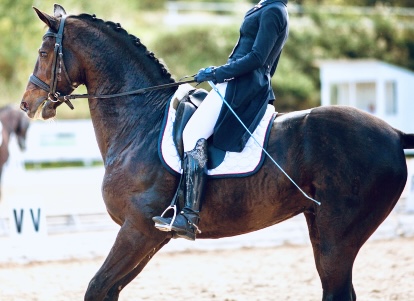
One of the biggest problems I see in modern dressage training is not force—it’s constancy.
Many riders are taught to keep the horse “on” all the time: on the aids, on the contact, on the leg. Connection and engagement are important, but when there is no real release, the horse never gets a chance to breathe—physically or mentally.
Over time, this creates horses that:
- Hold tension through their back and neck
- Move correctly on paper but without true swing
- Stop offering opinions, resistance, or even curiosity
These are often labeled as “good” horses because they don’t argue. But quiet compliance is not the same thing as relaxation. Some horses don’t fight—they just cope.
That coping eventually shows up somewhere else: soreness, behavior changes, sudden resistance, or a horse that simply feels flat and uninterested in work.
When ‘More Leg’ Becomes the Default Answer

Another place things go wrong is the constant push for more forward.
Forward is essential—but forward does not mean faster, tighter, or endlessly driven. A horse can go forward while still being balanced, relaxed, and mentally present.
When riders use leg as a solution for every problem without addressing balance or understanding, the horse often ends up rushing instead of carrying.
I see many horses labeled as lazy or behind the leg when, in reality, they are:
- Lacking strength
- Struggling with balance
- Unsure of what is being asked
Pushing these horses harder rarely fixes the issue. It usually just creates more tension and confusion. Dressage is supposed to develop the horse’s ability to go forward, not demand it before the body is ready.
Obedience Is Not the Same as Relaxation

One of the most misleading things in dressage is how easy it is to confuse obedience with harmony.
A horse can hit every movement and still be tight through the jaw, rigid in the neck, and braced through the back. The test may look clean, but the horse is often holding themselves together through tension rather than balance.
These horses are frequently praised as reliable or uncomplicated until they aren’t.
By the time issues surface, people often say the problem “came out of nowhere.”
In reality, the signs were there all along: shallow breathing, limited swing, a horse that stopped offering and started enduring.
The Cost of Skipping the Basics

Dressage is built on a progression, but modern training culture doesn’t always reward patience.
There is pressure to move up, to show, to produce results. Horses are often asked for collection, outline, and advanced work before they have the strength or understanding to do it correctly.
When that happens, the horse finds ways to compensate. Those compensation patterns may work for a while, but they come at a cost—usually paid in soundness or mental burnout.
There is nothing flashy about good basics, but they are what protect horses long-term. Time spent developing rhythm, straightness, and relaxation always pays off, even if it doesn’t feel exciting in the moment.
The Mental Side We Can’t Ignore

Perhaps the most overlooked piece of dressage training is the horse’s mental state.
Horses don’t experience pressure the way humans do. What feels like a small, constant demand to a rider can feel overwhelming to a horse, especially if there is no clear way to find relief.
Mental overload doesn’t always look dramatic. Sometimes it looks like:
- A delayed response
- A horse that freezes instead of reacts
- Sudden tension or spookiness
- A general loss of enthusiasm
These are often written off as training issues or attitude problems. More often, they’re communication issues.
Dressage should make horses more confident in their work, not more anxious about getting it wrong.
How We Can Do Better?

Doing better doesn’t mean abandoning dressage. It means returning to what it was meant to be.
- Release matters. Every aid should have a clear beginning and a clear end. Horses learn from the release, not the pressure.
- Train the horse in front of you. Not the one you had last week or hope to have next month.
- Relaxation comes first. A relaxed horse in a less-than-perfect frame is fathan a tense horse in a beautiful outline.
- Strength takes time. Collection cannot be forced — it has to be earned.
Mental breaks are not optional. Turnout, hacking, varied work, and true rest days are part of correct training, not a break from it.
What Dressage Is Meant to Be

When dressage is done well, it creates horses that are stronger, sounder, and more confident in their work. It improves communication and rideability across disciplines and throughout a horse’s career.
Dressage itself does not break horses. But when we rush it, misunderstand it, or stop listening to what the horse is telling us, even the best intentions can lead us in the wrong direction.
Doing better starts with paying attention—and being willing to slow down when the horse asks us to.
READERS: SHARE YOUR QUESTIONS & COMMENTS IN THE FORUM BELOW



One Response
I loved this article, Laura! When you wrote, “train the horse in front of you,” I’m taken back to the arena—teaching & how I remind students to…
“Put up a surgeons curtain where your hands are & ride what you FEEL in your seat & behind you. You CAN’T SEE the horse in front of you…only a green curtain, so you just get to FEEL the RESULTS of what your seat & leg do now in your hand. You’ll feel the trajectory of the angle of the reins to let you know where the horse’s head is, & you’ll feel the softness or tension on the bottom of your ring finger. It should be SOFT. If it’s not, ride with your shoulder blades deeper into your back, yield one rein & then the other, feel again. If it’s heavy, that’s a direct answer to the fact that the horse is not off of the leg & seat isn’t working enough.”
I don’t know HOW MANY TIMES I’VE SAID THAT, but it’s nearing the numerous hundreds of times over the past 27 years, but it works! Sometimes I wish I HAD a surgeons curtain! Lol.
Great job! —JKK