There’s a moment in riding, if you’ve been at it long enough, that you’ve probably felt at least once. The horse stops being something you’re managing and starts being someone you’re talking to. Not every discipline gets you there the same way. Some get you close. Western Dressage, I’d argue, gets you closer than most.
My family lives in Las Vegas, and that’s where I first encountered it. A woman named Annette Spanetti introduced me to the discipline, and what struck me immediately wasn’t the technical framework or the rulebook or the competition structure. It was her. Her enthusiasm was the kind that doesn’t perform itself, the kind that comes from someone who has sat with something long enough to truly understand why it matters. Her teaching, her dedication to the horses and to the method, got me hooked before I fully understood what I was getting hooked on.
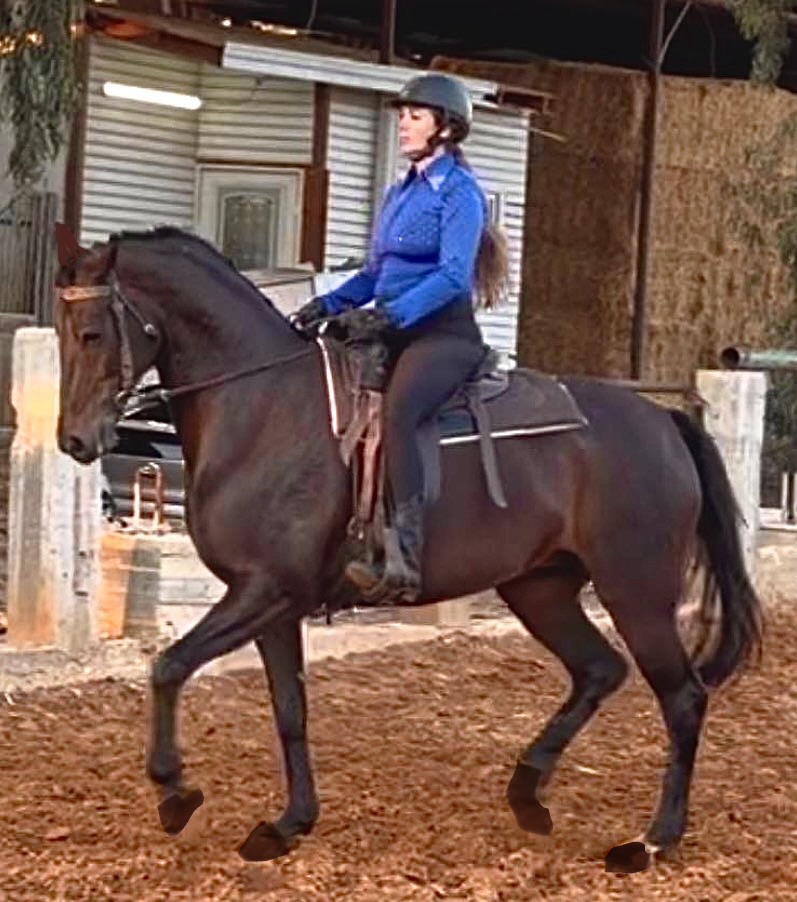
As an Arabian breeder living in Israel, I had no local community to turn to, no barn full of Western Dressage riders down the road, no shows nearby to work toward. To my knowledge, Western Dressage simply doesn’t exist here yet. What I had was Annette’s teaching, and it turned out that was more than enough to get started.
Two years later, I’ve competed in my first online show, I’ve set up a court (dressage arena) in my arena, and I’ve found myself part of one of the most genuinely welcoming equestrian communities I’ve encountered in thirty-plus years of working with horses.
Anyone who has shown horses for any length of time knows the particular anxiety of walking into the show arena where the politics are thicker than the arena dust. Judges who seem to be scoring relationships rather than horses. Local favorites who could ride in flip-flops and still pin first. It wears on you, eventually. I started showing in my youth and early adulthood, and I loved it, but I also learned quickly that ribbons don’t always tell the whole story.
Western Dressage has been, consistently and genuinely, different. The feedback I’ve received has been constructive in a way that actually means something, not vague praise or dismissive shorthand, but specific, usable observations about what my horse is doing and where we might go next. There’s a quote the Western Dressage Association of America seems to live by, one that I keep coming back to: “If you’re fond of a horse and wish to do him a real favor, train him well. You need never worry about the future of such a horse. Perhaps the greatest kindness you can do for any horse is to educate him well.” That’s not marketing language. It seems to be the actual organizing principle of the whole discipline, and you feel it in how people show up for each other. WDAA president Cindy Butler has said outright that the organization feels it’s saving horses’ lives through education, and that well-trained horses will always find a home. That kind of mission changes the culture of a sport, quietly but completely.
SO…WHAT ACTUALLY IS IT?
Western Dressage is, at its core, a systematic training method built on classical dressage principles and applied to the Western horse. What it means practically is this: it gives you a roadmap. Whether you have a professional trainer or you’re out on your property alone trying to figure out what to work on next, the discipline gives you a clear sequence, not a rigid formula but a thoughtful progression, for developing your horse into something more balanced, more athletic, and more genuinely willing.

The foundation is called the Training Wheel, a version of the Classical English Dressage Training Pyramid. You begin with rhythm, the regularity and evenness of the gaits, and build from there through suppleness, which is both physical and mental relaxation in the horse.
Then comes acceptance of the bridle, which is really about connection: that soft, honest line of communication between your hand and your horse’s mouth.
After that, impulsion, the horse’s desire to move forward from the
hindquarters, not just speed but energy and intention. Then straightness, which is less about going in a straight line and more about aligning the horse’s body so he can carry himself properly.
And finally, collection, where the horse begins to carry more weight on his hindquarters, freeing the front end and producing that effortless-looking carriage that makes you stop breathing a little when you see it done well.
What’s worth noting is that each of these elements is also affected by the rider. Lightness, throughness, and harmony are the goals woven through every stage of the wheel, not just at the end. You’re always working toward all of it, just with more nuance as you go. You don’t “complete” rhythm and move on… It’s more like a conversation that keeps deepening.
THE TESTS, THE LEVELS, & THE COURT

In Classical English Dressage, the Court would be the Arena. Like classical dressage, Western Dressage uses tests, patterns performed in a specific arena that tell you where to go, what gait to be in, and what the judge is evaluating. There are currently seven levels, each with four tests, and they build on each other in a way that makes the next step feel earned. Within each level, the tests also build on each other, starting from the foundation of a movement and then asking for a little more, and then a little more again.
The Intro level is exactly what it sounds like: walk and jog (Classical English Dressage—trot), large circles, halts, a free walk. It’s accessible by design, and that accessibility matters more than people sometimes admit. Cindy Butler, who has trained and judged for decades, recommends that everyone new to Western Dressage start at Intro, even if their horse can already counter-lope (Classical English Dressage—counter-canter) and change leads. Getting to know the geometry, feeling the transitions, understanding what a truly round circle feels like under you, that’s the work. The Basic level introduces the lope. By Level 1, you’re working on leg yields, serpentines, and backing. Level 2 and beyond bring in collected gaits, counter-lope, and more complex lateral work.
One thing that surprised me early on was how approachable the setup actually is. You can mow lines in your back pasture or use cones. The small court (short dressage arena) measures 20 by 40 meters and is used for Intro and Basic levels; the large court (large dressage arena) is 20 by 60 meters for Level 1 and above.
Letters along the perimeter, A, K, E, H, C, M, B, F among others, function like points on a map, telling you where each movement begins and ends. A 20-meter circle in the small court takes up essentially half the arena, which gives you a sense of both the scale and the precision required. The goal, as I’ve heard it put, is to make your circles “round like a bubble“—not banana-shaped, nor egg-shaped. Just round. Getting there is more work than it sounds.
WHAT THE GAITS ACTUALLY LOOK LIKE
This is where Western Dressage quietly challenges some assumptions about what a Western horse should look like going. Unlike Western Pleasure, and I say this with respect for that discipline’s own internal logic, Western Dressage wants forward. It wants an active, reaching, honest horse. Judges evaluate cadence, rhythm, top-line expression, consistency, and length of stride. The gaits are meant to show a horse who is genuinely moving through his body, with energy coming from behind.
The walk has three variations across the levels. The working walk should feel energetic and ground-covering, the kind your horse would have walking purposefully on a trail, not ambling, going somewhere. The free walk is where you give the reins and let the horse stretch his neck forward and down as a genuine reward, and judges watch carefully for whether the horse actually seeks that stretch or just tolerates the loose rein. There’s a real difference between the two, and horses will tell you honestly which one they’ve been trained to do. The collected and extended walk show the horse’s ability to either compact his stride with contained energy, or lengthen it while maintaining the same tempo, not rushing, just reaching.

The jog has one feature that makes Western Dressage particularly accessible for adult amateurs and returning riders: through Level 1, you’re allowed to post the jog. That’s not a minor thing. Sitting a jog well requires a degree of core stability and softness that takes years to develop, and allowing riders to post in the lower levels opens the door for horses and riders who are genuinely still building that foundation. By Level 2, sitting is expected, but ideally by then, you’ve built toward it honestly together rather than gritting your teeth through every test.

The lope should be a true three-beat gait, clear and unhurried, with the horse’s nose slightly in front of the vertical. Counter-lope, loping on the “wrong” lead intentionally, appears in the higher levels and is one of the most useful collection exercises there is. It requires the horse to balance himself in a way that straightforward loping simply doesn’t demand. When you feel a horse hold his counter-lope correctly through a corner, something shifts in how you understand balance.
SHOWING ONLINE WHILE LIVING THROUGH A WAR
I want to be direct about something, because it matters in a way that goes beyond logistics. I am an Arabian breeder living in Israel. To my knowledge, there is no Western Dressage community here, no shows, no local judges, no cluster of riders schooling tests on weekends. And for much of the past year and a half, I have been living through a war. The kind that reshapes what a normal day looks like, that makes planning feel almost absurd, that puts certain ambitions quietly on hold while everything around you is in motion.
My horses were still there. The work was still possible. And online showing made it matter in a way I hadn’t quite anticipated.
The process is simple enough on paper: ride your test, film it, upload to YouTube, and send the link to the online show. The Western Dressage Association of America—WDAA has a list of all online shows available on their website for the current year. A credentialed WDAA judge watches and sends back written feedback on every movement. But what it meant for me was something harder to put into words. It meant that in the middle of genuine instability, I still had a goal. I could school toward something specific, track my horse’s progress, and receive honest feedback from someone with no stake in my geography or my politics. That feedback loop, the sense that the work counted and someone was actually paying careful attention to it, turned out to be more sustainable than I would have predicted.

The online component of Western Dressage expanded significantly during COVID and it hasn’t looked back. The Online International Challenge, held every June, draws riders from multiple countries, including entire teams from places like Sweden, all filming in their own pastures and arenas and sending in links. Riders who place receive a jacket with their placing on the back of it.
You can film on your phone. You can redo a ride if you weren’t happy with it. You can do the whole thing without a trailer, without travel, without the particular kind of nervous exhaustion that comes from hauling a horse to a showground and hoping the day holds together. For someone in a country with no live shows in this discipline, and living through the uncertainty during a war, that accessibility isn’t a consolation prize. It’s the whole point.
It also stripped away something I’d sometimes used as an excuse in earlier years: the logistics, the expense, the travel. When you remove all of that, what’s left is just your ride. And your ride is where the work actually was all along.
ANY HORSE. ANY RIDER. ANYWHERE.
Western Dressage has done something unusual in the equestrian world: it’s built a discipline that genuinely means it when it says everyone is welcome. At the World Show, you’ll find Quarter Horses, Warmbloods, Arabians alongside gaited breeds, mules, donkeys, draft crosses, and horses that defy easy categorization. The WDAA has trained its judges to recognize the conformation of each individual horse and evaluate it accordingly, rather than holding every animal against a single template.
Scoring itself works on a one to ten scale per movement, with ten meaning excellent and six meaning satisfactory, meaning you accomplished it, even if it wasn’t pretty. What that system offers, beyond fairness, is resilience. Every movement is a new opportunity for a ten. If you blow a lead change, that’s one movement out of perhaps nineteen or more. You can still win the class. You go home with written comments on every score and the judge’s overall impressions on the back of the test, and you take all of it into your next schooling session. The system never lets you off the hook and it never leaves you without direction.
WHAT IT COMES DOWN TO
Western Dressage isn’t trying to make your horse into something he isn’t. It’s trying to find what he already could be and give him the tools to get there. The system exists to serve the horse, to give him a body that can carry itself, a mind that trusts the work, and a way of going that makes him genuinely pleasant to ride and a horse that people will want to keep. The greatest kindness you can do for any horse is to educate him well. I keep returning to that. It doesn’t announce itself. It just sits there, and the more time you spend in the work, the more weight it seems to carry.
Social Media:
READERS:ASK A QUESTION OR LEAVE A COMMENT IN THE FORUM BELOW


2 Responses
We received a political statement from a reader. This website is about equestrian interests, not political ones. —DressurSPORT.com LLC (Admin)
What a great article you have written. I love WDAA and have shown in it extensively over the last 10 years. Your article is right on. It’s all about the journey. I also want you to know that I am praying for all of Israel and both the US and Israeli military and for you and your family and animals specifically! Hang in there and be safe so you can write and ride more in the future. 🙏