A gathering place for classical & western dressage, eventing & equestrian enthusiasts
DressurSPORT.com
SITE SELECTION FOR BUILDING AN EQUESTRIAN ARENA
Site selection is the most underestimated and least understood phase of arena development. Long before construction methods, materials, or maintenance practices are considered, the land itself imposes constraints that cannot be engineered away. Equally important, however, is how the arena relates to the rest of the facility and how it will function day to day. Many arenas that struggle operationally or require excessive maintenance were not built incorrectly. They were built in the wrong place.
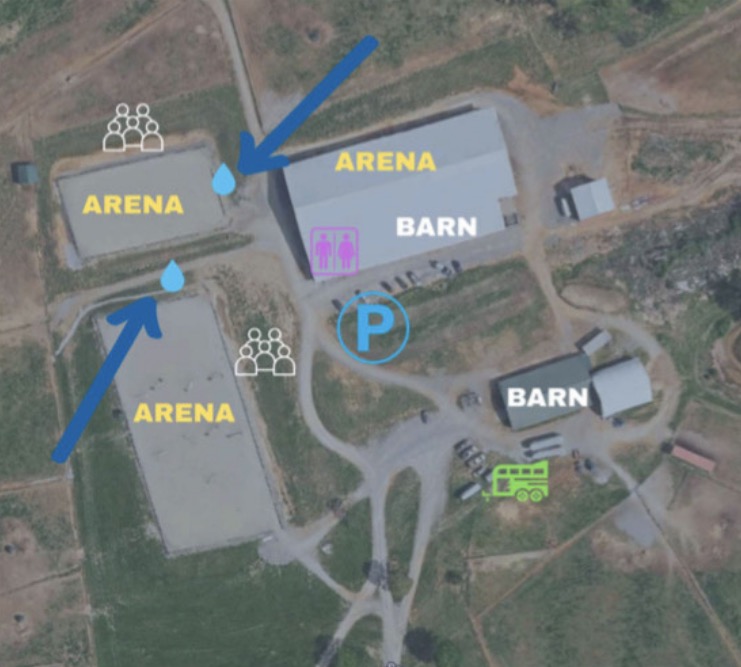
Proximity to barns is often one of the first considerations in site selection, and when handled correctly, it can be a significant advantage. Shorter travel distances improve daily efficiency, reduce wear on access routes, and make routine use more convenient, particularly in boarding and lesson facilities. However, arenas placed too close to barns and other structures frequently inherit problems associated with roof runoff, hardscape drainage, and concentrated water discharge. Buildings upslope of an arena can deliver large volumes of water directly into the arena footprint unless those flows are intercepted and redirected. In many cases, a location that appears convenient ultimately creates long-term drainage challenges that outweigh its initial appeal.
Proximity to amenities should be evaluated with equal care. Reliable access to water is essential for arena operation and maintenance, and availability should be confirmed early in the planning process. Electrical access may be required for lighting, irrigation controls, or equipment storage. Tractor and groomer storage should be close enough to encourage consistent maintenance without creating traffic conflicts or safety concerns. In boarding facilities or locations where students and clients will regularly use the arena, bathrooms and safe pedestrian access are not optional considerations. These elements affect how the arena is used daily and how well it integrates into the overall facility.
Emergency access and proximity to roads are critical but frequently overlooked. Arenas must be accessible to emergency vehicles, veterinary services, and trailers under all conditions. Narrow drives, steep grades, soft surfaces, or poorly designed entrances can delay response during critical situations. Seasonal access is particularly important in regions affected by snow, mud, or freeze-thaw cycles. A site that becomes difficult to reach during part of the year introduces risk that extends beyond convenience and into safety and liability.
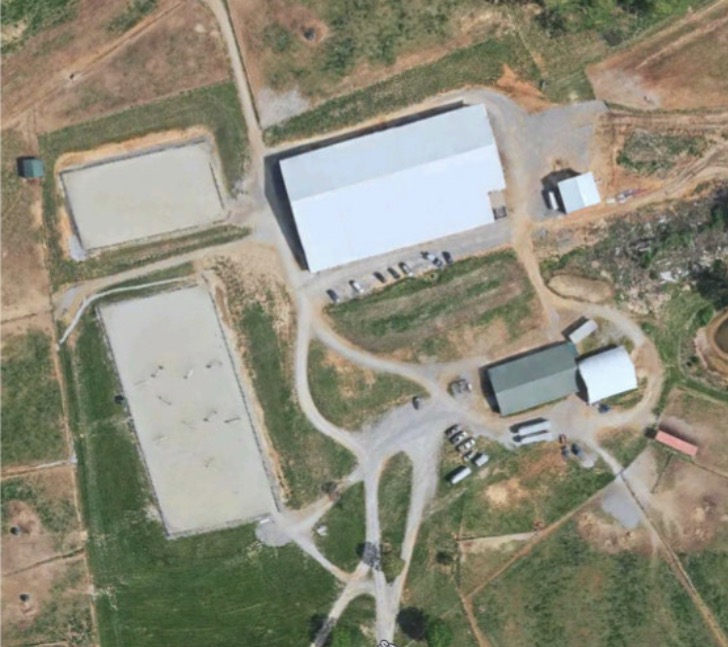
Aerial photo of site plan for arena
Access roads serving the arena should be considered part of the site selection decision, not an afterthought. Grades, turning radii, surface durability, and drainage all influence long-term usability. Delivery of materials, routine maintenance, and daily traffic place repeated stress on these routes. Poorly planned access roads often become ongoing maintenance problems and can limit how effectively the arena is used.
The relationship between the arena and surrounding pasture areas is another factor that significantly affects usability and safety. While proximity to turnout areas may seem efficient, arenas placed immediately adjacent to active pastures often create distractions that undermine the riding environment. Horses running fence lines, interacting across shared boundaries, or reacting to activity just outside the arena can compromise focus and increase risk. Most riders prefer a degree of separation that allows the arena to function as a controlled space. Thoughtful site selection considers buffers, sightlines, and the behavioral impact of surrounding horse activity.
Natural buffers such as distance, elevation change, or vegetation can be used effectively to separate the arena from high-activity areas without sacrificing convenience. These buffers often serve multiple purposes, including wind reduction and drainage management, reinforcing the importance of evaluating the site as a whole rather than as a single flat location.
Once proximity and operational relationships are understood, natural drainage becomes the most critical factor in site selection. Every property has an existing hydrologic pattern that dictates how water moves during rain events, snowmelt, and seasonal saturation. Water rarely travels in straight, obvious paths. It spreads as sheet flow, concentrates along subtle contours, and often moves laterally through shallow soil layers before surfacing downslope. An arena placed in a natural low point, drainage convergence, or receiving area will always be fighting water regardless of how well it is built.
• The arena should be located close to a reliable water source to make footing maintenance easier.
• Ensure there is sufficient water pressure and flow for irrigation and watering systems.
• Install underground water lines or easy hose access to prevent dragging long hoses across the property.
• Evaluate whether a water truck or irrigation system is needed based on the arena size, climate needs, and pressure/flow rate of the water source.
Uphill slopes deserve particular attention. Even gentle grades above a proposed arena location can deliver significant volumes of water during sustained rainfall. This water does not need to be visible at the surface to cause problems. Subsurface and near-surface movement can saturate soils beneath an arena long before surface runoff is observed. Sites that appear dry during fair weather often reveal their true behavior only during prolonged or intense rain events.
Cut and fill requirements are closely tied to drainage and are a major driver of cost and complexity. Shallow cut and fill can often be managed predictably and economically. As cut depths increase, construction becomes exponentially more complex. Deep cuts expose unstable soils, disrupt natural drainage planes, and create abrupt transitions that must be managed structurally. Large fills introduce settlement risk, extended compaction requirements, and longer construction timelines. Both conditions increase the likelihood of drainage complications if not carefully planned.
Retaining walls are frequently introduced to address site constraints created by poor location choices. While they may appear to offer a clean solution, retaining walls carry significant construction cost and long-term responsibility. They must be engineered to withstand soil pressure, hydrostatic loading, and, in many regions, freeze-thaw cycles. Improperly drained retaining walls often become water collection points, concentrating moisture exactly where it is least desirable. From a site selection standpoint, any location that requires extensive retaining structures should be evaluated critically.
Native soil conditions play a central role in determining whether a site is appropriate. Sandy soils may drain quickly at the surface but lack cohesion and bearing strength, requiring reinforcement or stabilization. Silty soils are highly sensitive to moisture and can lose strength rapidly when saturated. Expansive clays exhibit shrink-swell behavior that can disrupt grading and stability over time. Selecting a site with challenging soils does not make construction impossible, but it does introduce additional expense through geogrid reinforcement, soil stabilization, increased section thickness, or more aggressive drainage strategies. These costs should be understood before a location is chosen, not discovered mid-project.
Portland cement stabilization and geogrid reinforcement are sometimes used to address poor soil conditions, but both represent added complexity rather than simple solutions. Stabilization changes the fundamental behavior of the soil by reducing flexibility and internal drainage. Geogrid requires precise material compatibility and installation to function as intended. From a site selection perspective, the need for these measures should prompt careful evaluation of whether a different location on the same property could reduce overall cost and long-term risk.
Ultimately, site selection is about aligning natural conditions and operational needs with intended use. The best arena locations are not always the flattest or most visually obvious. They are the locations where drainage can be managed predictably, earthwork can be accomplished efficiently, access is reliable, and surrounding uses support rather than interfere with the arena’s function. When these factors are addressed early, construction becomes simpler, costs are more predictable, and long-term performance improves dramatically.
This article establishes the principles of site selection as they relate to facility layout, natural drainage, soil behavior, access, and operational integration. Construction methods and sub-base design build upon these decisions, but they cannot correct them. Selecting the right site is the first and most important step in creating an arena that performs consistently and remains manageable over time.
READERS: SHARE YOUR QUESTIONS & COMMENTS IN THE FORUM BELOW
About The AUTHOR
RICHARD “DICKIE” OSBORNE 🇺🇸
Richard “Dickie” Osborne is the co-founder of Precision Equestrian Arenas and co-creator of the Precision Arena System™—a repeatable, systematic framework for arena design that can be applied anywhere, on any site, in any region, for any discipline. With over 30 years in the field, he has built a reputation for solving arena challenges others struggle with, including drainage failures, unstable footing, and inconsistent contractor practices. Osborne also co-developed The Precision Arenas’ Academy, which houses the only online course for Equestrian Arena Planning and Construction, and leads one of the largest Facebook communities for footing design, Equestrian Footing Design and Planning. Known for his precision, practicality, and relentless work ethic, Osborne is dedicated to creating arenas that last, ride predictably, and protect both horse and rider through thoughtful design—not guesswork.