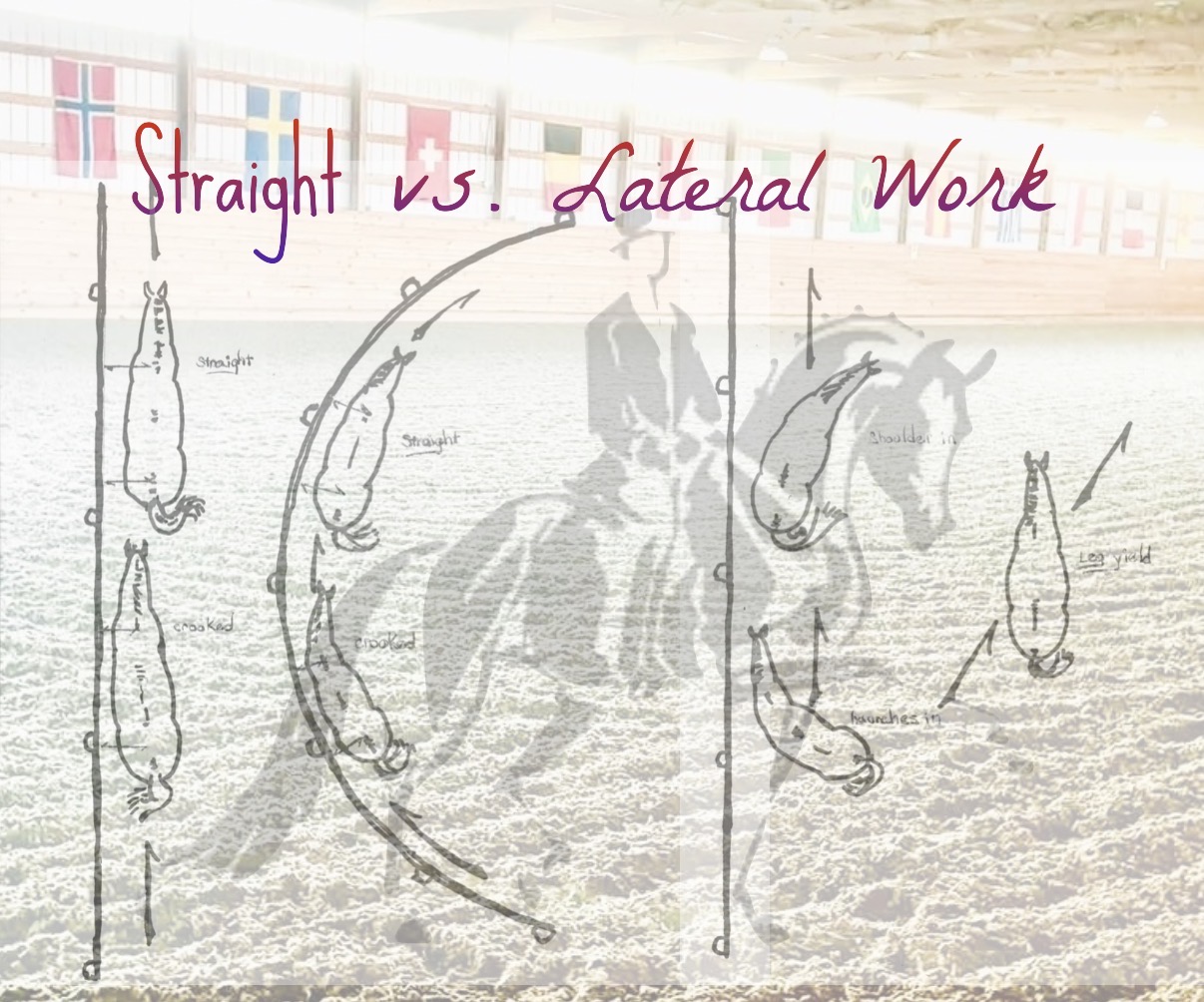
There are many references that teach how to ride a specific exercise, and these methods can vary from reference to reference, day to day or trainer to trainer but if the rider does not comprehend what the exercise requires, they cannot hope to execute it correctly. If it is not executed properly, it will be ineffective at best or damaging at worst.
Riding and training a horse boils down to a very logical process. It is equivalent to teaching Math to someone. If a person cannot understand basic addition and subtraction, they will never learn long division. If a horse does not know how to move in a straight line and understands how to move off the leg, it will never understand a higher-level movement. Every step in horse training should lead to another. There are no shortcuts.
Training exercises consist of school figures; all school figures are made up of both straight lines and circles. These are ridden either straight or laterally with the express purpose of teaching the horse something or building certain muscles. Many riders do not understand the purpose of the schooling exercises they are executing, nor what the elements that make up the exercises are meant to achieve. When the desired results are not what the rider expected; the horse bears the cost for the rider’s lack of understanding.
STRAIGHT WORK
Straight work has the horse’s hind leg tracks along the same line as the front, either on the straight line or on a circle.
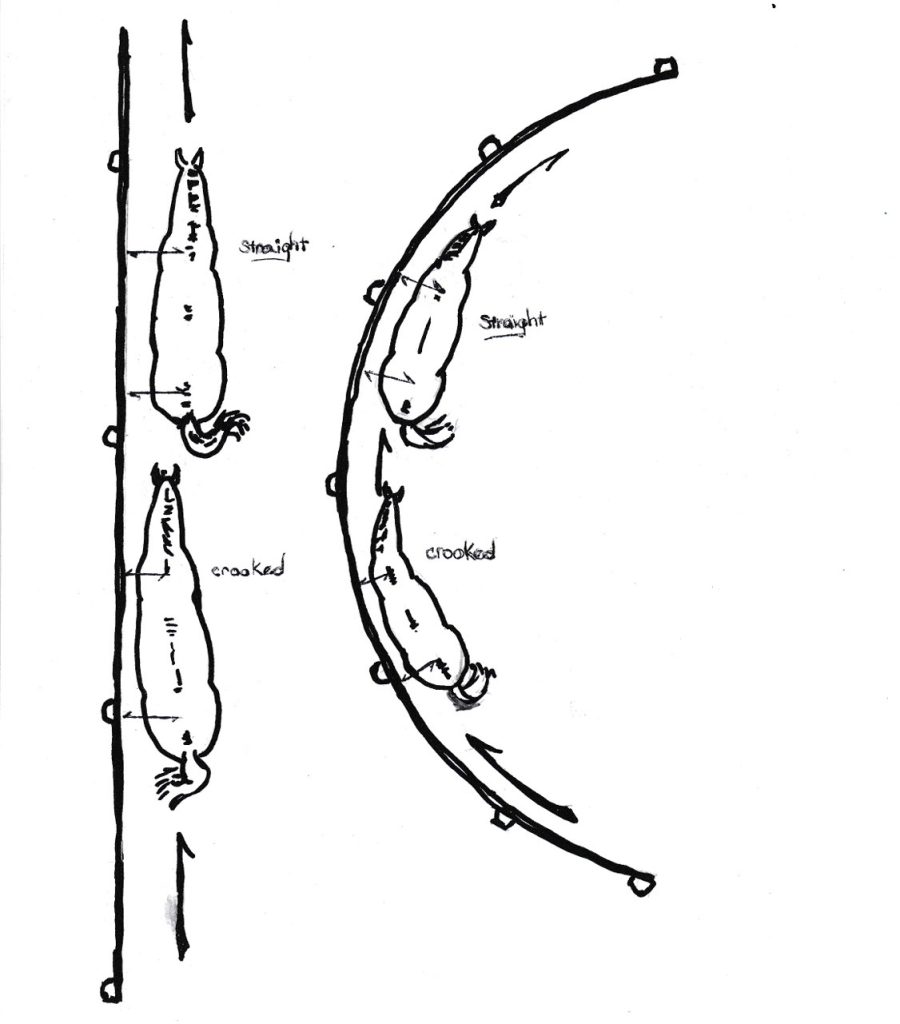
Straight work, when ridden correctly, helps to teach the horse to stay straight in their body. When the horse is straight in its body, depending on the gait, it must lift its shoulder to free the front legs before the hind legs can come forward. To free up the shoulders the horse must start to become more active behind.
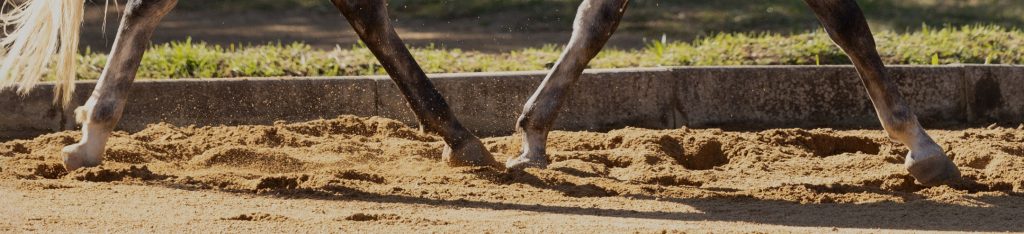
If the horse doesn’t lift over the shoulders, it will have to shorten the length of the hindleg’s stride to avoid injuring itself. The horse will often throw its hindquarters either in or out to avoid engaging its core, back, and lifting through the wither in order to free up the shoulders. It is less work for the horse, but it does not achieve the goal of the exercise.
To ride straight on a circle the horse must bend its neck as well as behind the saddle to balance without falling in or out. The smaller the circle, the more engagement is required of the inside hind leg. That does not mean the rider should start off with small circles, instead the rider should start with a circle the horse can perform easily and gradually make the circle smaller as the horse’s ability increases.
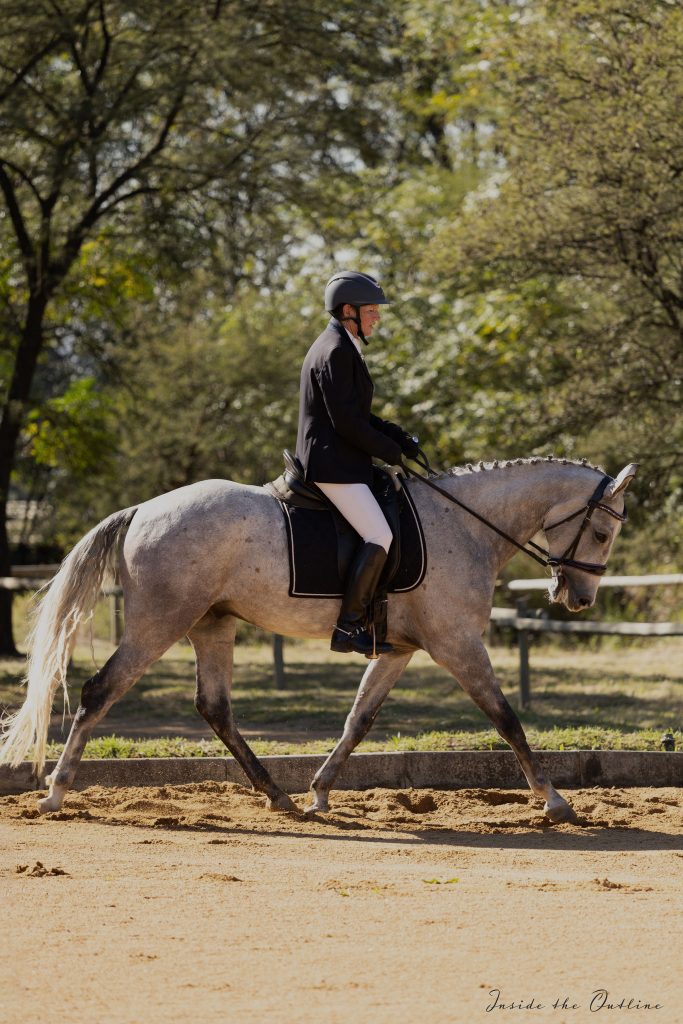
When schooling a horse for straightness, the rider needs to keep in mind that the horse is shaped like a wedge. Its shoulders are narrower than its hindquarters. If the horse’s shoulder and hip are the same distance from the track, the horse is crooked. It is the horse’s spine that needs to be parallel to the track or rail for it to be straight. If schooling a circle, the horse’s spine should be in line with the circle.
LATERAL WORK
Lateral work will help the horse learn balance both horizontally and vertically.
It is important to realize that a horse’s greatest fear is falling. Running is their main defense when frightened or threatened. If they fall and they cannot get up to flee, they are at their most defenseless from predators, so for them it can be a death sentence. Balance is very important to them; being unbalanced will cause anxiety, tension, and fear. The most common response a horse has to being unbalanced is rushing, or to hurry through an exercise in order to get back to a place in their work where it is balanced, and thus “safe”.
If a horse moves one part of its body without moving another part, it must learn to transfer the weight of the leg it is moving to another leg or legs to prevent it from losing its balance and possibly falling. By teaching the horse to move its weight from leg to leg, from its front onto its hind end, it builds the knowledge and muscle-memory to stay balanced in an exercise.
Lateral work teaches the horse to bring its hind leg more underneath of itself, moving more weight onto the hindlegs and helping its balance. It makes the horse aware of its hind legs and teaches it to become more active behind.
THE THREE BASIC FORMS OF LATERAL WORK
While the horse is moving forward:
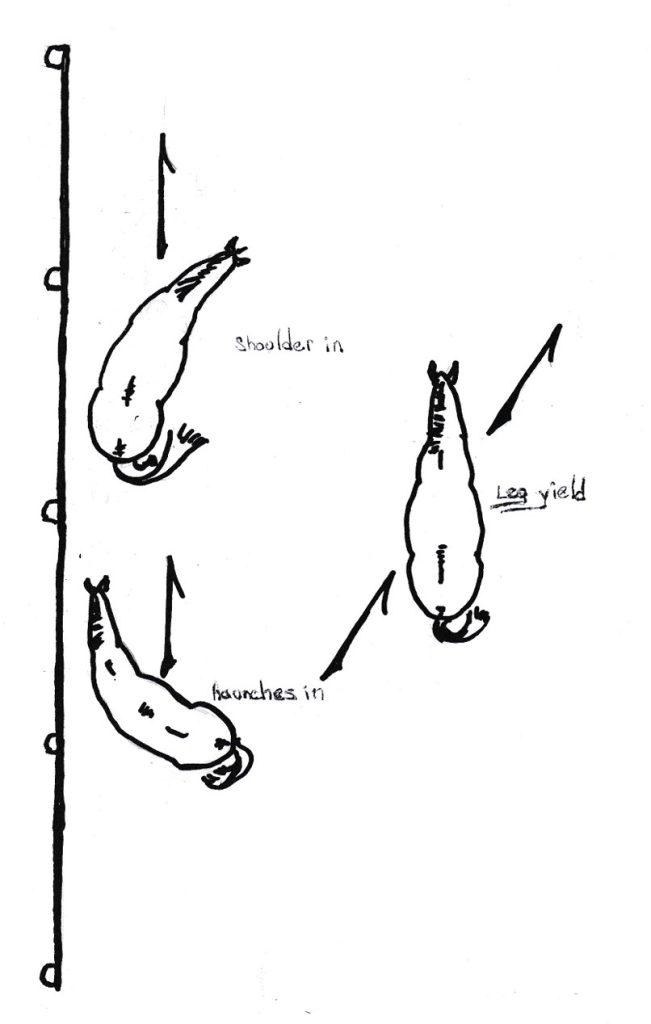
- Moving the entire body of the horse. Leg Yielding
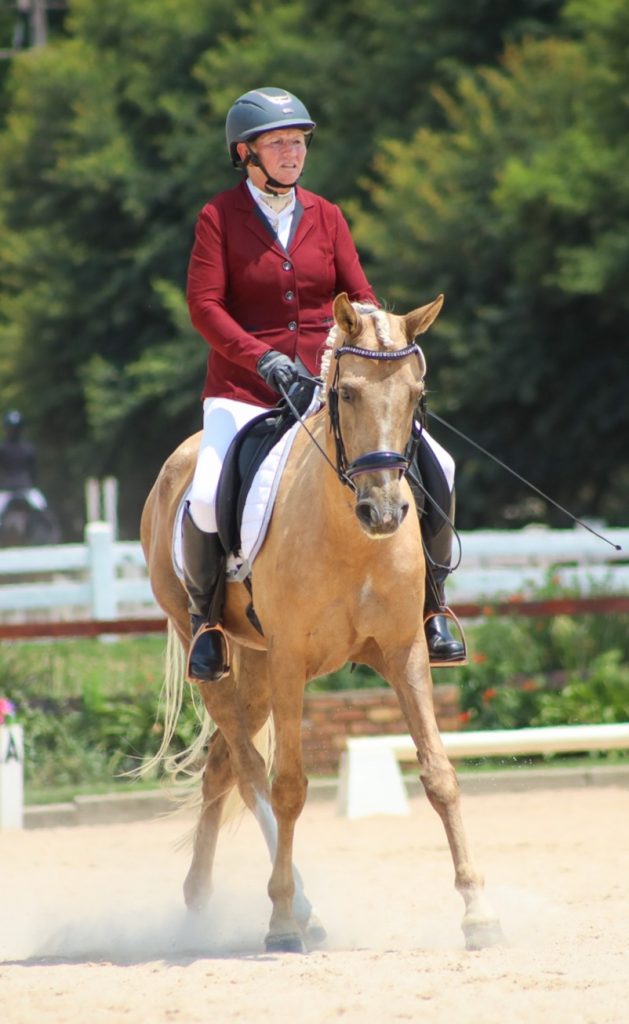
When doing a leg yield, the inside with the bend opposite of the line of movement. The legs of the horse should cross in front of the outside legs—This is the beginning of training the horse to move away from pressure, which will later be used in teaching the horse the other lateral movements.
- Moving the shoulders WITHOUT the hips: Shoulder-In
In the Shoulder-In: the horse should bring the inside hindleg (into the bend) forward and under the horse, closer to its mid-line and in front of the outside hindleg.
- Moving the hips WITHOUT the shoulders: Haunches-In or Travers.
The Hanches-In, or Travers, should bring the OUTSIDE hind leg to the inside of the horse, closer to the mid-line, and in front of the inside hind leg.
If these 3 things can be taught to the horse, given time and strength, the horse will have the basics to proceed further in its training.
Note: A Western “Side Pass,” does not have to have any forward element in this form of lateral work. All dressage lateral work must have an element of forward as well as sideways. The Side Pass will not look to move forward to the uneducated observer, but the leg moving should cross in front of the leg standing.
To teach the horse lateral work they must first learn to “yield to the leg.” Yield To The Leg means just that: when pressure is applied by a specific leg of the rider, the horse must yield to or move the same hind leg as the leg the rider’s using. By using leg, the horse can interpret the aid in two ways:
- The horse can go forward in a straight line, or
- If the forward motion of the horse is partially constricted, the horse can move away from the pressure of the rider’s leg and in the process start to cross both front legs and hind legs simultaneously to maintain its balance.
- Once the horse has learned to move its whole body away from pressure, then the rider can start moving the shoulders without moving the hips or moving or the hips of the horse without moving the shoulders.
These two movements are the basis of every lateral movement. It is extremely important to train them correctly, if not, then the training that follows will not be correct.
THE LEG YIELD
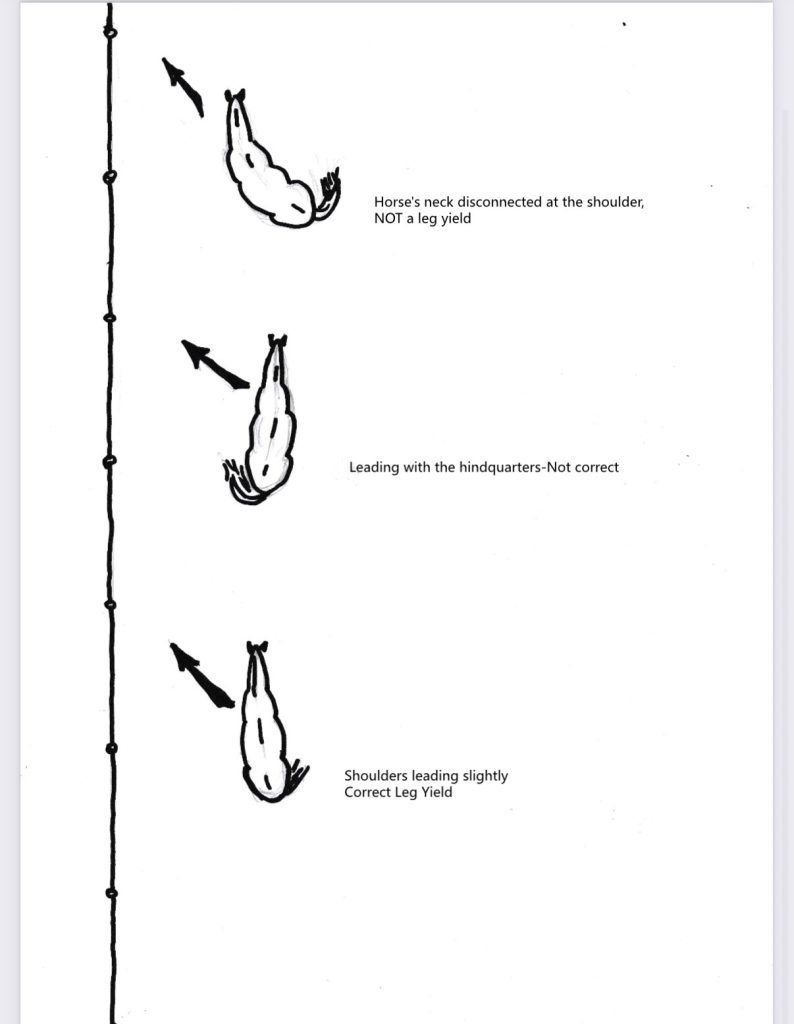
To ride the leg yield the rider will need to do the following:
—inside leg is just behind the girth in order to ask the horse to move forward as well as sideways.
—outside leg is slightly back and guarding the horse’s haunches from drifting to the outside.
—The outside hand has the fingers closed and weighted but not “fixed,” with soft, supple wrists, and relaxed forearms.
—inside hand is pliable, positioned to keep the horse’s head straight in front of it. The rider will accomplish this by keeping their shoulders positioned the same as the horse’s shoulders. The inside seat bone of the rider will be slightly back and weighted, which will encourage the horse to move away from the pressure both it and the rider’s active leg are aiming in the direction for.
It is important to remember that a leg yield is a straightening exercise, not a bending one, so there should be only a very slight bending in the neck, enough to only see the horse’s eye (the opposite one than the direction of movement).
START WITH GROUND WORK
To help the horse understand what is being asked of it, it is always better to prepare it by doing the proper groundwork, so the horse already knows HOW TO MOVE AWAY FROM PRESSURE.
- Always start by asking for 1 or 2 steps sideways then allowing the horse to go forward in a straight line as a reward.
- If the rider is working in an arena, start by riding the horse a meter or 2 off the rail or side of the arena, then asking for it to step towards the track.
- The horse is accustomed to working on the track, so it should willingly move over to it.
- As the horse gains strength and understanding, the distances traveled in leg yield will become longer.
BEGINNING THE SHOULDER-IN
The shoulder-in is the next step. The aids are the same as a leg yield except the rider is riding a straight line with the horse’s shoulders to the inside, so the outside front leg lines up with the inside hind leg.
The moving of the hindquarters without the shoulders: Start on the ground to ask the horse to move the hindquarters away from pressure while keeping the shoulders still.
FROM THE GROUND: This can be done by the handler standing on the side, using one rein on that side to bring the horse’s head slightly towards the handler’s body, then asking with a whip or the pressure of a finger for the horse to move its hindquarters in the other direction.
TURN ON THE FOREHAND
Once the horse is established in the groundwork, the rider can then start to ask for a turn on the forehand by restricting the forward motion with both of their hands while using their lower leg on the opposite side of the direction they want the horse to move its quarters to. The rider will move the leg they want the horse to move away from back towards the animal’s hindquarters and ask the horse to move away from the pressure applied. The aim is for the horse to plant the inside front leg and move it’s haunches around and away from the rider’s leg but if the horse does move forward, but has made an effort move its quarters away from the rider’s leg, the horse should still be rewarded by being allowed to move forward freely in a straight line. Precision will come with time and training.
Once the horse can do a Turn-On-The-Forehand easily and without a lot of resistance, it will be time to start teaching the Haunches-In, or Travers.
TURN-ON-THE-HAUNCHES
To ride the Turn-On-The-Haunches the rider will need to do the following:
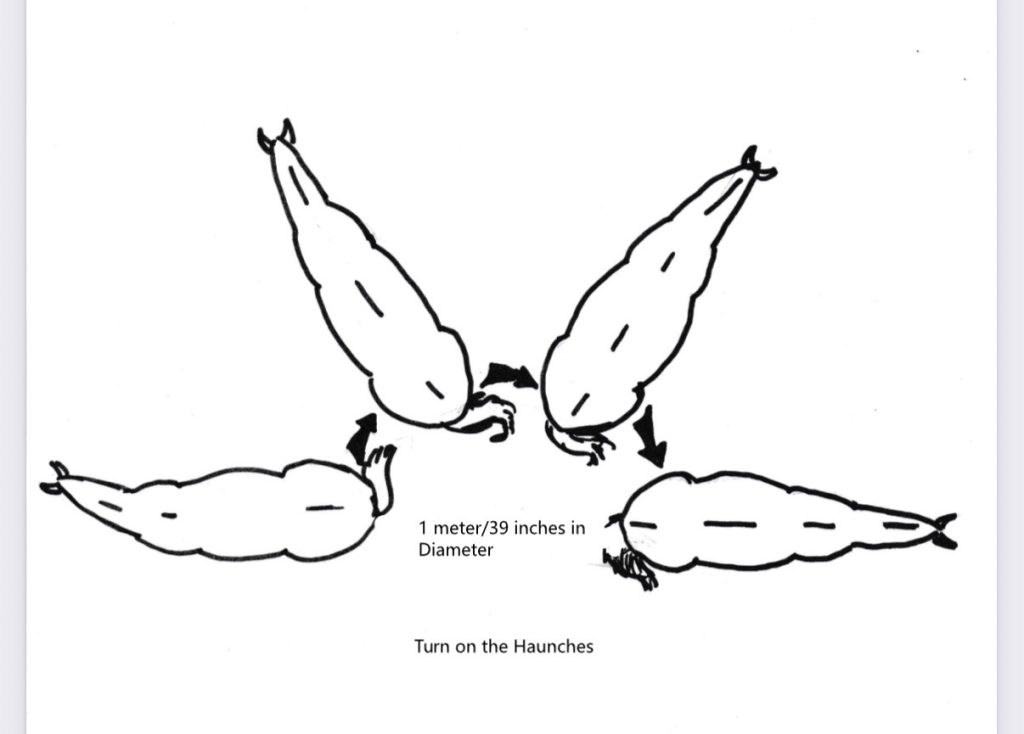
—Put the outside leg back, then place the inside leg just behind the girth. Maintain weight on the inside seat bone, which will ask the horse to carry its hindquarters slightly towards the inside of the track while working in a straight line.
—Start on the rail: sitting on the inside seat bone. Keep forward energy with the inside leg, while placing the outside leg back asking in rhythm with the outside hind reaching forward to stretch their leg further under its body mass as well as towards the inner track. Only use the leg in rhythm with the outside hind’s coming forward motion.
Talking of how steep the angle should be: A little is good and as the horse will find its strength and balance. Eventually more angle can be asked for until the horse is able to easily work on 4 tracks (each leg is moving in a separate line when observed from the front).
COMBINED LINES & CIRCLES, STRAIGHT & LATERAL
The problem in riding often lies in the rider forgetting to ride the movement they are in. When riding a corner, even though it is only 25% of a circle, it is part of a circle and should be ridden that way. If it is not ridden, the horse will lack bend and can fall on its inside front leg. In a dressage test, a turn down the center line is a 10-meter half-circle. If it is ridden as such, the horse will arrive on the center line balanced and engaged-prepared to go straight.
Riding on the long sides of the arena, the horses are often found with their shoulders to the outside. They are unbalanced and falling to the outside, arriving at the next movement unprepared, and they are certainly not ready for the rider to ask for any lateral work, which will only compound the problem.
Combining lines and circles, straight and lateral can give the rider endless opportunities to create endless combinations to help the horse develop into a balanced, and athletic animal by giving the rider a chance to work on problem areas as well as helping to identify gaps in the horse’s training.
READERS: SHARE YOUR QUESTIONS & COMMENTS IN THE FORUM BELOW
SOCIAL MEDIA: