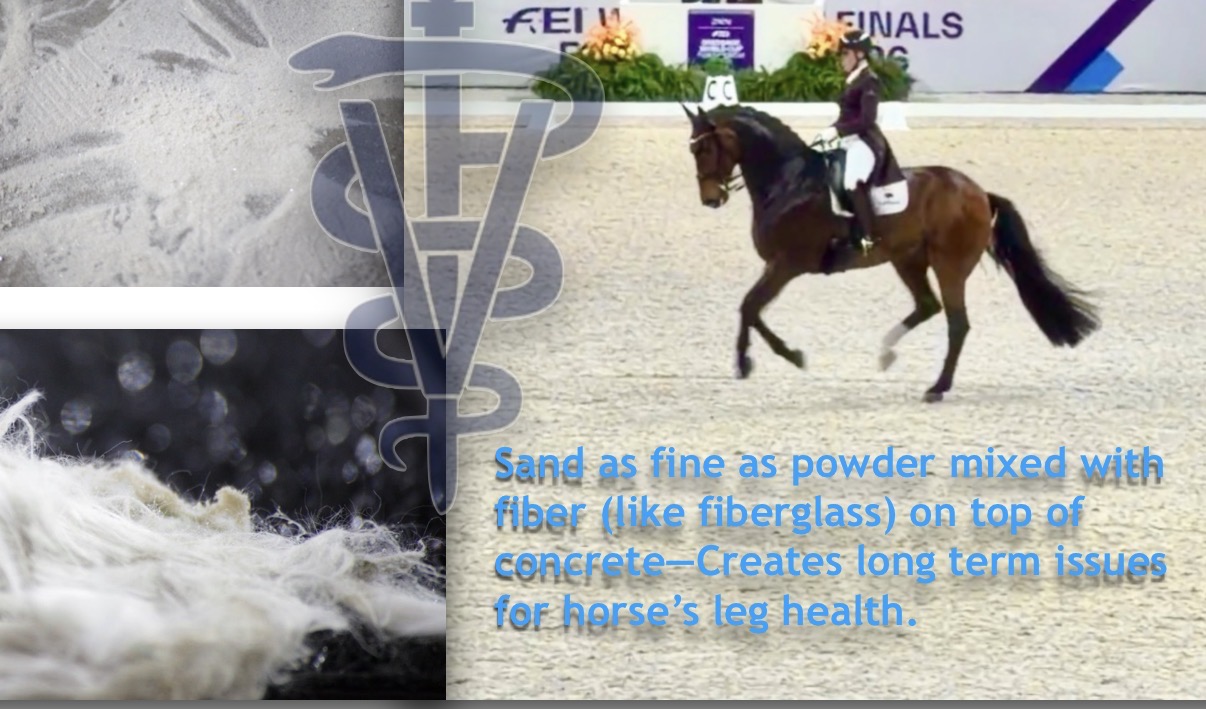
The modern equestrian surface industry has become increasingly dependent on a formula that appears sophisticated on the surface: fine, uniform sand combined with high fiber content, heavy moisture management, and regular mechanical testing. At the highest levels of sport, these surfaces are often praised because they look clean, consistent, and controlled. They do not move much. They do not cut up. They photograph well. They test well on certain mechanical devices.
But the question the industry must be willing to ask is this: are these surfaces truly better for the horse, or HAVE WE SIMPLY BECOME BETTER AT BUILDING FOOTING THAT SATISFIES A NARROW INTERPRETATION OF TEST NUMBER

A riding surface is not just a platform. It is part of the horse’s mechanical system. Every landing, every turn, every push-off, and every recovery stride is influenced by how the surface absorbs force, allows hoof rotation, releases shear, and returns energy. Surface firmness, cushioning, responsiveness, grip, and uniformity all directly influence what the horse feels under load.
The concern is not that fiber is always bad. The concern is that fiber has become a substitute for understanding sand.

Fine, uniform sand is inherently limited. Because the particles are similar in size, the material lacks the broad gradation needed to create natural stability through particle interlock, controlled pore structure, and moisture-holding complexity. A stable sand blend should not require excessive fiber to hold itself together.

When fine uniform sand is used as the primary material, fiber becomes the crutch. The surface is then engineered around the additive instead of around the soil mechanics of the sand itself.

When enough fiber is added, the surface begins to knit together. That tight knitted mat may feel secure to a rider and may produce favorable firmness or consistency readings, but it can also become harsh. Instead of allowing controlled displacement, hoof slide, and release, the surface can begin resisting movement too aggressively.
This is where the modern interpretation problem begins.
The industry has become fascinated with measurement. Hoof-drop simulators, impact hammers, surface testers, shear devices, and other technologies can all provide useful information.
⚠️The problem is not the equipment.
⚠️The problem is assuming that numbers alone equal understanding.
A surface can test “consistent” and still be mechanically wrong for the horse. A surface can be firm, uniform, and visually perfect, yet provide too little release under the hoof.
A horse does not need a surface that is dead tight. It needs a surface that supports, cushions, allows controlled rotation, provides appropriate grip, and releases force at the correct time. Harder surfaces stop downward hoof motion more abruptly, increasing concussion, while excessive grip or shear resistance can interfere with the natural slide and rotation the limb expects during landing and breakover.

This is where untimed or out-of-phase rebound becomes critical. The surface may absorb and return energy, but if that return happens at the wrong moment in the stride, it does not help the horse. It loads the horse.
A surface that rebounds too quickly, too late, or too uniformly can create a mechanical timing problem. The rider may feel spring. The testing equipment may record responsiveness. But the horse may be receiving force when the limb is not in the correct position to use it safely.

This is especially concerning in modern show jumping, where the horse is landing from significant height, loading one limb disproportionately, rotating through the joints, stabilizing the body, and preparing for the next effort in fractions of a second. The timing of force absorption and release matters immensely.

Watch many major venues today and you will see footing that barely moves. That has become the visual standard: no displacement, no cut, no visible failure. But immobility is not the same thing as safety. A surface with little visible movement may simply be transferring more of the work into the horse’s joints, tendons, ligaments, and bone.
The industry often interprets visible movement as weakness. In reality, controlled movement is part of how surfaces dissipate energy. The horse was never designed to land on a platform that behaves like tightly compacted synthetic carpet.
THE PROOF MAY ULTIMATELY BE FOUND IN LONGEVITY
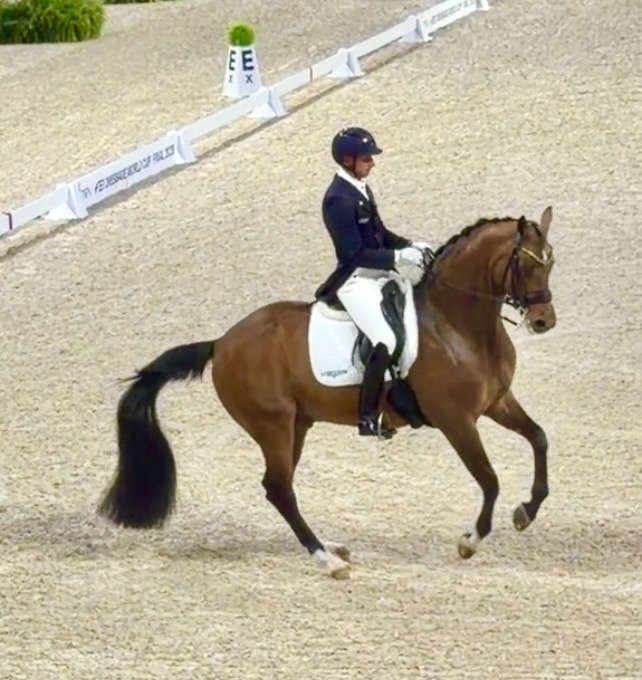
Many experienced horsemen and veterinarians have quietly questioned why so many elite horses appear to have shorter competitive windows despite all of the advances in modern footing technology. Better diagnostics, better nutrition, and better veterinary care should theoretically support longer careers. Yet concerns surrounding repetitive stress injuries, joint strain, suspensory injuries, and cumulative wear continue to grow.

Of course, footing is not the sole variable. Breeding, training intensity, competition schedules, economics, and management all play roles. But it should raise a serious question: if our surfaces are supposedly more advanced than ever, why are so many veterinarians increasingly concerned about overly firm, overly tight, synthetic-feeling footing? To read this article on suspensory ligaments, visit:

https://www.eliteequinesa.com/elite-equine-and-suspensory-ligament-injuries-in-sport-horses/
THE INDUSTRY’S WEAK POINT IS THE KNOWLEDGE BASE BEHIND THE DESIGN
Many modern footing designers understand which fine sand works with their chosen fiber. That is not the same as understanding sand. They know how to build a surface around an additive, but often do not understand how to build a stable sand profile before the additive is ever introduced.

THAT DISTINCTION MATTERS
A TRULY STABLE FOOTING begins with SOIL SCIENCE: gradation, particle shape, angularity, fines content, moisture behavior, compaction response, capillary structure, shear behavior, and discipline-specific loading. Fiber should be used, if used at all, as a refinement. It should not become the structural foundation of the footing.
One of the most concerning realities in the modern footing world is that many influential designers and consultants have little or no background in soil science. They may understand testing equipment. They may understand branding. They may understand how to market proprietary systems. But understanding soil mechanics, capillary behavior, compaction dynamics, particle distribution, and how surfaces evolve over time under equine traffic is an entirely different field of expertise.
Somewhere along the way, the industry began confusing technological complexity with true understanding. THE RESULT IS A GENERATION OF SURFACES ENGINEERED TO SATISFY MEASUREMENTS RATHER THAN HORSES.
The future of arena footing should not be LESS science. It should be BETTER science.
🚫Not just mechanical readings.
🚫Not just firmness numbers.
🚫Not just surfaces that look perfect on livestream.
The industry needs designers who understand the horse, the discipline, and the soil beneath the hoof. Until then, we will continue to see surfaces that test well, ride fast, look immaculate, and quietly ask the horse to absorb the consequences.

VET & SOIL STUDIES:
1. Kentucky Equine Research. Hoof Slip on Different Surfaces in Horse Arenas.
2. Denoix, J.-M. Equine Locomotor Pathology and Biomechanics. International Society of Equine Locomotor Pathology (ISELP).
3. Horan, K., et al. (2024). Hoof slip duration at impact in galloping Thoroughbred ex vivo limbs on turf and synthetic surfaces. PLOS ONE, 19(10), e0309118. Available via PMC11469542 (nih.gov).
THE FIBER PROBLEM WITH MODERN EQUINE FOOTING SYSTEMS: Why the Horse Needs to Slide
—by Dickie Osborne🇺🇸 & Michael DePew
The modern equestrian surface industry has become increasingly dependent on a formula that appears sophisticated on the surface: fine, uniform sand combined with high fiber content, aggressive moisture management, and regular mechanical testing. At the highest levels of sport, these surfaces are often praised because they look clean, consistent, and controlled. They do not move much. They do not cut up. They photograph well. They often perform well on mechanical testing devices.
But the question the industry must be willing to ask is this: Are these surfaces truly better for the horse, or have we simply become better at building footing that satisfies a narrow interpretation of test numbers?
A riding surface is not merely a platform beneath the horse. It is part of the horse’s mechanical system. Every landing, every turn, every push-off, and every recovery stride is influenced by how the surface absorbs force, allows hoof rotation, releases shear, dissipates energy, and returns energy.
French equine biomechanist and Veterinarian Dr. Jean-Marie Denoix summarized this concept with a simple observation: “If the footing isn’t moving, the hoof is.” That statement deserves far more attention than it receives.
When a horse lands, the hoof does not simply strike the ground and stop. It moves. It rotates. It slides. It dissipates energy. The entire musculoskeletal system relies on that movement to reduce stress and distribute force.
Research examining hoof-surface interaction has shown that the hoof normally slides forward during impact before stabilizing.
On highly engineered waxed or synthetic surfaces, the hoof may slide approximately 1.9 inches (4.9 cm).
On more traditional sand-based footing, the hoof may slide approximately 2.9 inches (7.4 cm).
That movement occurs remarkably fast. Depending on gait and conditions, the stabilization process occurs in as little as 13 to 18 milliseconds at the trot and approximately 33 milliseconds at the walk.
Think about that for a moment.
The hoof is moving several inches in a fraction of a second.
‼️That slide is not failure.
‼️That slide is not instability.
✅That slide is part of how the horse dissipates impact forces.
The problem begins when footing becomes so tight, so cohesive, and so resistant to movement that normal hoof displacement becomes restricted.
‼️This is where the modern fiber discussion becomes important.
‼️The concern is not that fiber is inherently bad.
‼️The concern is that fiber has increasingly become a substitute for understanding sand.
Many discussions focus on the type of fiber being used. In reality, the type of fiber may be far less important than the system in which it is being used.
The more significant concern is the growing reliance on very fine, highly uniform sands combined with fiber and moisture to create stability.
Fine, uniform sand is inherently limited from a soil mechanics perspective. Because the particles are similar in size, the material lacks the broad gradation necessary to create natural stability through particle interlock, pore structure complexity, moisture retention characteristics, and controlled shear behavior. A properly engineered sand should contribute significantly to its own stability.
Instead, many modern surfaces rely heavily on synthetic additives to create cohesion.
‼️Fiber becomes the structural component rather than the refinement.
‼️The surface is no longer engineered around the sand.
‼️The sand is engineered around the fiber.
‼️As fiber content increases, the footing begins to knit together into a more cohesive matrix. Riders often describe these surfaces as secure, springy, consistent, and predictable. Mechanical testing devices may record favorable firmness, impact, or uniformity readings.
YET AN IMPORTANT BIOMECHANICAL QUESTION REMAINS:
❓What happens when the hoof attempts to move and the footing resists that movement?
📐The equestrian industry has become fascinated with measurement.
🧲Hoof-drop simulators, impact hammers, surface testers, shear devices, and other technologies all provide useful information.
THE PROBLEM IS NOT THE EQUIPMENT
⚠️The problem is assuming that numbers alone equal understanding.
⚠️A surface can test consistet and still be mechanically wrong for the horse.
⚖️A surface can be firm, uniform, visually perfect, and still provide too little release under load.
A horse does not need a surface that is dead tight.
❤️It needs a surface that supports, cushions, allows controlled rotation, provides appropriate grip, and releases force at the correct time.
💥Harder surfaces stop hoof motion more abruptly, increasing concussion. Excessive grip or excessive shear resistance can interfere with the natural slide and rotation the limb expects during landing and breakover.
⚠️This concern becomes especially important in modern show jumping.
A show jumper lands from significant height while loading individual limbs disproportionately. During landing, the horse must absorb tremendous forces, stabilize the body, rotate through the joints, rebalance, and prepare for the next effort within fractions of a second.
⏱️THE TIMING OF FORCE ABSORPTION AND RELEASE MATTERS IMMENSELY.
This brings us to a concept that Michael DePew and I have spent YEARS discussing: UNTIMED REBOUND.
To be clear, Untimed Rebound is our theory. It is not currently a published scientific term.
Michael is a soil scientist with more than thirty-five years of experience in equine footing design and has written a white paper exploring the concept. The theory is straightforward. Energy return is not automatically beneficial.
A surface may absorb and return energy, but if that return occurs at the wrong phase of hoof loading, braking, rotation, stabilization, or breakover, it may not assist the horse at all.
⚖️Instead, it may become additional loading.
🌀The rider may feel spring.
📈The testing equipment may record responsiveness.
🐎Yet the horse may be receiving force when the limb is not mechanically positioned to utilize that force safely.
⚡️The concern is not simply how much energy is returned.
⏳The concern is when.
⏱️Timing matters.
🧲🧲A horse’s stride is not a single event. It is a sequence of events.
🎰If footing changes that sequence, it changes the forces experienced by the horse.
One of the most concerning trends at major venues today is the visual expectation that footing should appear almost motionless.
🚫No displacement.
🚫No visible cut.
🚫No disturbance.
🚫No movement.
🔬That has become the visual standard of success.
YET IMMOBILITY IS NOT THE SAME AS SAFETY.
Controlled movement is part of how surfaces dissipate energy.
The horse was never designed to land on a platform that behaves like tightly compacted synthetic carpet.
The industry often interprets visible movement as weakness.
In reality, controlled movement may be one of the mechanisms that protects the horse.
Another question is beginning to emerge among veterinarians, judges, riders, trainers, and horsemen.
While no formal research currently demonstrates that elite sport horses are experiencing shorter careers because of modern footing systems, many experienced professionals have begun asking whether current footing philosophies deserve closer examination.
Whether those concerns ultimately relate to footing, breeding, training intensity, competition schedules, advances in diagnostics, economics, or some combination of factors remains unknown.
⁉️WHAT IS KNOWN IS THAT THE QUESTION IS BEING ASKED⁉️
And questions worth asking deserve investigation.
The industry’s greatest weakness may not be the footing itself.
It may be the knowledge base behind the design.
💬Many modern footing designers understand which fine sand works with a particular fiber package.
That is not the same thing as understanding sand.
💬Understanding additives is not the same thing as understanding soil mechanics.
💬Understanding testing equipment is not the same thing as understanding particle-size distribution, particle shape, capillary behavior, moisture dynamics, compaction response, shear characteristics, and how footing evolves under years of equine traffic.
That distinction matters.
A truly stable footing begins with: ✅soil science.
✅Gradation.
✅Particle shape.
✅Angularity.
✅Moisture behavior.
✅Compaction response.
✅Capillary structure.
✅Shear behavior.
✅Discipline-specific loading.
✅Fiber, if used at all, should be a refinement.
🚫It should not become the structural foundation of the footing.
🚫The future of arena footing should not be less science.
🚫It should be better science.
🚫Not just mechanical readings.
🚫Not just firmness numbers.
🚫Not just surfaces that look perfect on livestream.
🧠The industry needs designers who understand the horse, the discipline, and the soil beneath the hoof.
‼️Until then, we risk continuing down a path where surfaces test beautifully, ride fast, look immaculate, and quietly ask the horse to absorb the consequences.
Join our Equestrian Footing Design and Planning Faceboo Group: https://www.facebook.com/groups/1093425374971972
TO ASK QUESTIONS OR COMMENT, PLEASE DO SO IN THE FORUM BELOW
SOCIAL MEDIA:
📞: 1-844-EQ-ARENA
🌐: http//www.precisionequestrianarenas.com
i


